GC-MS Profiling and In-vitro Antidiabetic Activity of Leaf Extracts of Ravenala madagascariensis Sonn.
DOI:
https://doi.org/10.5530/ctbp.2026.4.40Keywords:
Anti-diabetic, α-amylase, GC-MS, Ravenala madagascariensis SonnAbstract
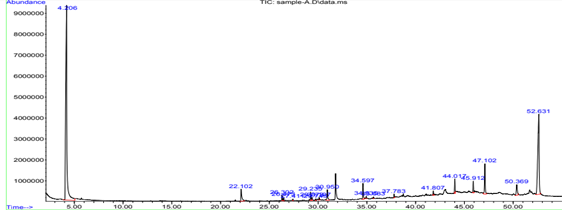
This study aimed to document the GC-MS profile and in-vitro α-amylase “and α-glucosidase” inhibitory activity of Ravenala madagascariensis Sonn. The shade-dried and powdered plant material after successive Soxhlet extraction with n-hexane and ethyl acetate was subjected to gas chromatography- mass spectrometry (GC-MS) analysis, followed by α-amylase and α-glucosidase inhibition using standard acarbose. Various bioactive compounds, including phytol, tritetracontane, squalene, tetratriacontane, γ-tocopherol and its ester derivative, with peak area percentages of 5.05, 5.94, 4.15, 14.96, 11.41, 43.93%, respectively, were recorded in n-hexane extract. The ethyl acetate extract also showed compounds including 2-Pentanone, 4-hydroxy-4-methyl derivative, 7,9-Di-tert-butyl-1-oxaspiro(4,5) deca- 6,9-diene-2,8-dione, phytol, (+)-γ-Tocopherol, O-methyl derivative, Tetratriacontane and γ-Tocopherol with a peak area percentage of 53.25, 2.08, 2.20, 24.64, 4.77, 2.65% respectively. Moreover, in-vitro analysis indicated that the ethyl acetate extract exhibited stronger α-amylase inhibitory activity (IC₅₀ = 91.75 μg/ mL) compared to the n-hexane extract (IC₅₀ = 229.78 μg/mL), with potency approaching that of the standard drug acarbose (IC₅₀ = 78.72 μg/ mL). In the α-glucosidase inhibition assay, the n-hexane and ethyl acetate extracts showed IC₅₀ values of 59.40 μg/mL and 54.40 μg/mL, respectively, which were comparable to that of the standard metformin (IC₅₀ = 55.49 μg/mL). In summary, the ethyl acetate leaf extract of Ravenala madagascariensis Sonn. exhibited potent α-amylase inhibitory activity, indicating its potential to reduce postprandial glucose levels, while both extracts showed significant α-glucosidase inhibition, aiding in delayed carbohydrate digestion and glucose absorption. The presence of diverse volatile phytoconstituents further supports their biological activity, highlighting the plant’s promise for development into an effective antidiabetic formulation.